




-
Partager cette page
Multi-Method Geophysical Surveys Between and Around the Kerlescan and the Manio Megalithic Alignments in Carnac (Morbihan, France)
Un article de G. Bruniaux, V. Mathé, O. Agogué, S. Lopez, P. Paillou, R. Perschke, V. Ard
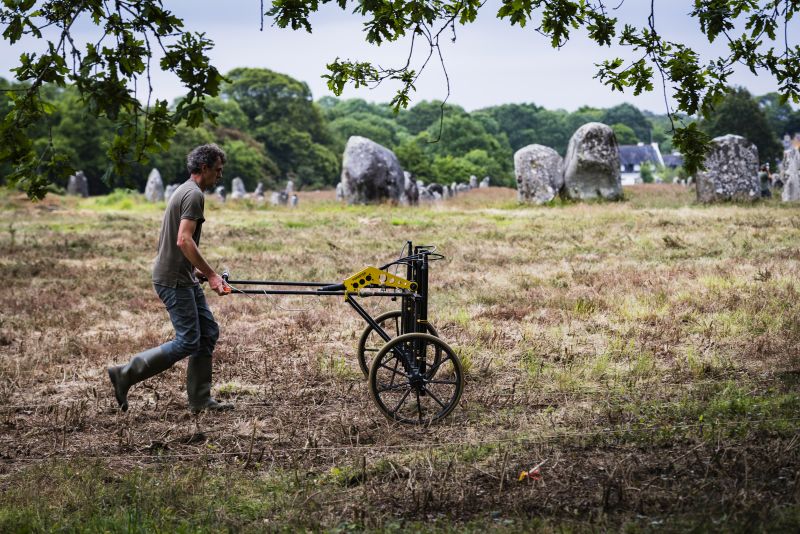
L'article Multi-Method Geophysical Surveys Between and Around the Kerlescan and the Manio Megalithic Alignments in Carnac (Morbihan, France) vient de paraître dans Archaeological Prospection. Il s'agit des résultats des prospections effectuées à Carnac par l'équipe de V. Ard, V. Mathé et P. Paillou.
Une équipe de CNRS Images était venue réaliser un reportage sur place, au moment des prospections. La vidéo est à retrouver sur la chaîne YouTube du CNRS.
The Carnac alignments in Morbihan (France) are among the most famous Neolithic sites of the world. Paradoxically, they have benefited little from a thorough renewal of archaeological data over the past century. There are many reasons for this, but it is mainly because the site has been regarded more as a monument to visit and protect than as an archaeological site to be explored through excavation. The largest archaeological intervention in the menhir alignments had been the excavation ‘Manio 2’ burial mound by Zacharie Le Rouzic and the Péquart in 1922. Research and conservation efforts slowed down after Zacharie Le Rouzic died in 1939, except for the excavations carried out on the Kerlescan site between 1940 and 1942 during the German occupation by Werner Hülle. After World War II, preserving the site became the priority. Intense research into megalithism in the region came to a halt and shifted to other areas of Brittany and did not include the Carnac alignments. However, several grey areas remain, particularly regarding the shape and location of the settlements associated with the Carnac alignments, such as ditches, fences, postholes and hearths. These structures were obviously more discreet and undoubtedly accompanied the menhir alignments and burial mounds. Discoveries made during preventive excavations around Carnac have revealed a high density of cooking stones and monoliths, which were undetectable during surface surveys because of their burial.
Therefore, the possibility of discovering such structures using geophysical methods is a significant research challenge that offers considerable potential for expanding our knowledge. The objective of the 2024 geophysical surveys was to evaluate the effectiveness of modern geophysical methods in detecting underground structures related to the Carnac alignments. These surveys built on the expertise developed through the ANR MONUMEN program in central-western France. This article summarizes the initial results of the geophysical surveys of the Carnac alignments.
Crédit image : © Cyril FRESILLON / TRACES / LIENSs / LAB / CNRS Images