




-
Partager cette page
New insights into the Trans-Saharan gold trade in the Islamic Middle Ages revealed by multi-isotopic (Pb–Fe–Cu) and elemental characterization of Fatimid gold coins
Un article de L. de Palaminy, S. Baron, F. Poitrasson, R. Kool, M. Blet-Lemarquand, F.-X. Fauvelle
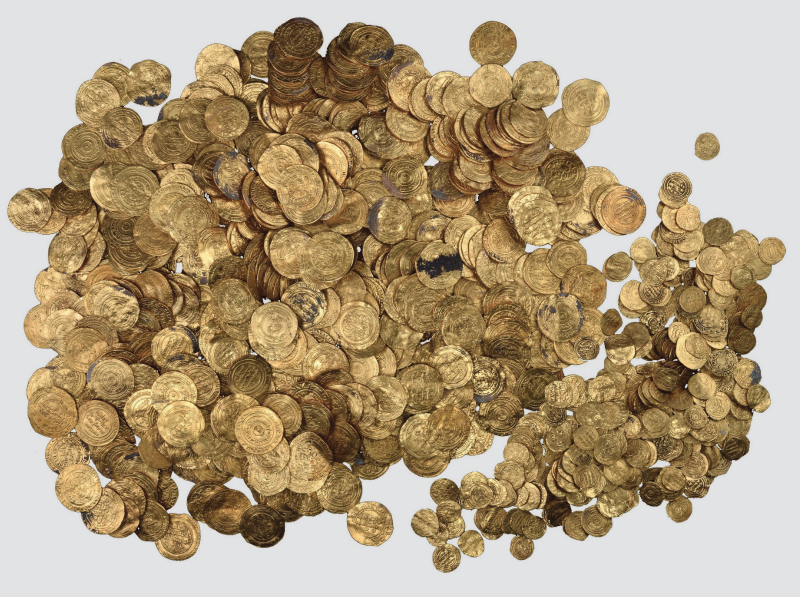
The use of West African gold in medieval times is thought to have enabled the first globalized trade in history: the Trans-Saharan Trade, through the minting of Islamic dinars, which were considered as the equivalent of today’s dollar or euro currencies. Yet, the precise origin of this gold remains debated, as archaeological evidence for such trade is scarce. While textual sources are numerous, they provide only indirect accounts, and the large corpus of surviving dinars has so far yielded limited insight as elemental analyses are not discriminating enough to establish geological provenance.
To address this, we combined multi-elemental analysis by LA-ICP-MS with multi-isotope (Pb, Cu, and Fe) data measured by MC-ICP-MS after wet purification chemistry on 11 dinars. This revealed two distinct metal stocks, differentiated by PGE concentrations and Cu isotopes. The Cu and Fe isotope signatures are consistent with supergene and oxidized ores, typical of West African gold mineralization. In contrast, the lead isotopes and calculated model ages of the gold coins do not match the signatures expected for West African mineralization, suggesting that a different, exogenous source is involved in the gold chaîne opératoire. These new data then raise two key historical questions: the location of gold processing, whether it occurred North or South of the Sahara, and the hypothetical reuse of older metal stocks