





-
Partager cette page
Early Palaeolithic cobble-based technologies from the Mekong fluvial terraces: new data and technological insights from eastern Cambodia
Un article de J. Guibert et al.
Abstract
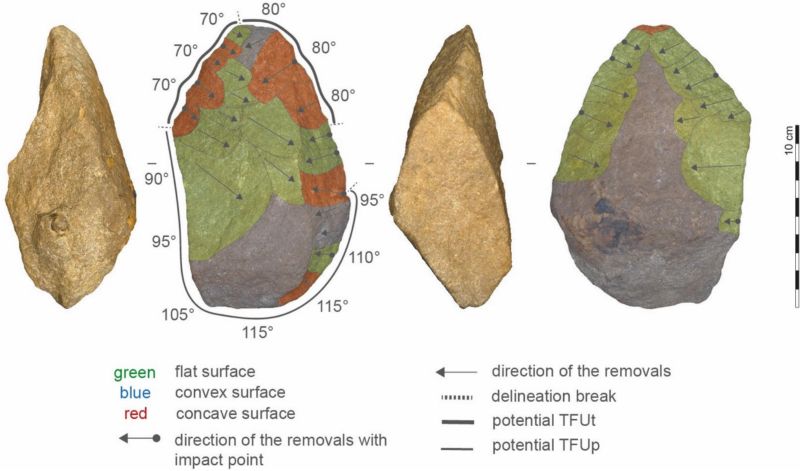
The earliest phases of the Palaeolithic in mainland Southeast Asia remain poorly documented due to the scarcity of well-contextualised sites and the frequent lack of secure stratigraphic frameworks. Within this fragmented record, the Quaternary fluvial terraces of the Mekong in eastern Cambodia constitute a key archaeological context, first identified by Edmond Saurin in the 1960s but only rarely reassessed since. This article presents new data from lithic assemblages discovered along a section of the Mekong River between Stung Treng and Kratié, combined with a technological re-evaluation of earlier collections. The study is based on 126 original lithic artefacts from 12 localities, with a focus on the most representative assemblages (Thalaborivat 1 and 2, O Preah and Sré Sbau) integrated within their geomorphological framework. A combined techno-productional and techno-structural analysis highlights reduction strategies based on the flexible exploitation of cobbles through shaping and flaking. These technical characteristics fall within the range of behavioural variability attributed to the Early Palaeolithic in the region. The results confirm the archaeological validity of earlier discoveries, reveal a significant but still underexplored artefactual potential for Palaeolithic archaeology, and emphasise the importance of the Mekong as a major corridor of human occupation during the Middle Pleistocene in Indochina peninsula.